
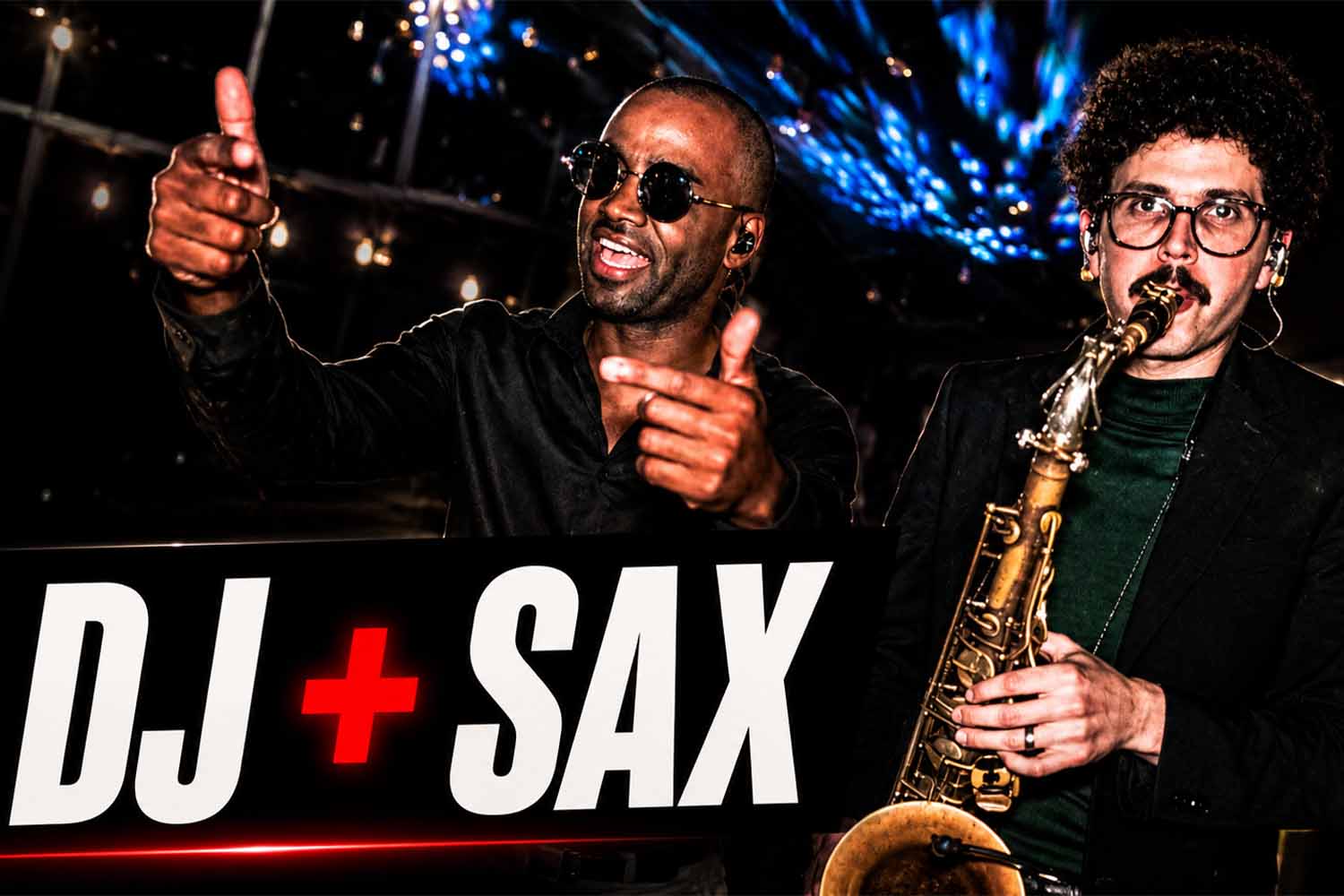
Hey! I’m Mike, I go by DJ AXCESS, and I’m a DJ, public speaker, and business coach based in Columbus, Ohio.
Watch the full video here: [YouTube Link]
Live sax at a wedding can completely change the energy in the room.
Not because it is loud. Not because it is flashy. Not because it is a gimmick.
It works when the sax player understands timing, song choice, crowd interaction, and how to collaborate with the DJ in real time. That is exactly why I enjoy working with sax player Justin Dickson.
For this wedding at Jorgensen Farms Oak Grove, Justin joined me for cocktail hour, dinner, and multiple dance floor sets. This was not just a musician showing up and playing over songs. It was a planned collaboration built around the couple, the room, the music, and the moments that needed to feel special.
This post is a chance to get to know Justin, how he approaches wedding performances, and what actually goes into adding live sax to a DJ set.
Who Is Justin Dickson?
Justin has been playing saxophone since eighth grade, and by his own estimate, he has played around 250 weddings. Most of his work has been with wedding bands, but he has also been building experience performing with DJs at weddings, corporate events, birthdays, and private events.
That background matters.
A sax player who comes from a live band environment understands performance, phrasing, dynamics, and how to fit inside a bigger musical picture. A sax player working with a DJ also needs a different kind of awareness. The songs move faster. The transitions can happen quickly. The energy can shift in real time.
That is one of the things Justin does well.
He is not just playing notes. He is listening, reacting, and watching the room.
The Setup Behind Live Sax at a Wedding
One of the biggest differences between a traditional sax performance and a DJ plus sax setup is the gear.
Justin uses a wireless pack attached to his saxophone with 3M Dual Lock. That allows him to move around without keeping the pack on his belt, which makes it easier to put the horn down when needed. His wireless signal runs back to a Shure receiver, then through his pedal board, then into my DJ setup so the sax can come through the main sound system.
That setup gives him flexibility.
He can move through the dance floor, interact with guests, and still stay connected to the sound system. For a wedding, that makes a big difference. Live sax is most effective when it feels like it is part of the party, not trapped on a stage in the corner.
Justin also brings a battery-powered speaker for cocktail hour. He can connect his iPad, read charts, and play along with music from Spotify or Apple Music when needed. For cocktail hour or dinner, that allows the sax to create atmosphere without needing the full DJ system running at dance floor volume.
That is where live sax can be especially useful. It can be background ambiance early in the day, then become a high-energy feature later in the night.
How Justin Chooses Music
One thing I appreciate about Justin’s approach is that he does not just take a playlist and copy it song for song.
He looks for the couple’s taste profile.
That might mean noticing artists they like, pulling a few direct requests, and making sure he includes songs that show he did his homework. He mentioned that he likes to include a handful of songs the couple specifically asked for because it helps them feel heard.
That is a small detail, but it matters.
A wedding performance should feel personal without becoming rigid. If every song is locked in too tightly, you lose the ability to react. If everything is improvised with no connection to the couple, the performance can feel disconnected from the event.
The right balance is preparation plus flexibility.
For this wedding, Justin’s sets were split across different parts of the night. Cocktail hour gave him more freedom. Dinner leaned more toward traditional jazz. The dance floor sets were built around recognizable songs, strong horn moments, and energy that matched the room.
That is the right way to think about it.
Live sax should not feel the same at 5:00 p.m. as it does at 10:00 p.m.
Why Song Choice Matters for Sax
Some songs naturally work better with sax.
Justin mentioned songs like “September,” Dua Lipa records, and tracks with recognizable horn parts. When a song already has a horn line, guests immediately understand what is happening. They recognize the part. They feel the live element. They react faster.
That does not mean sax only works on songs with horn parts.
Actually, some of the most creative moments happen when there is no obvious sax line. That gives Justin room to stretch out and add something new. The key is knowing when to play the melody, when to improvise, and when to leave space.
That last part is important.
A great sax player does not need to play over every second of every song. The live element works best when it feels intentional. Too much can dull the shine. Justin said the same thing when talking about set length. He usually plays around 25 to 30 minutes on the dance floor, depending on how people are reacting.
That is the right instinct.
Live sax should create peaks, not flatten the whole night.
How DJ and Sax Coordination Works
The more Justin and I play together, the easier the coordination becomes.
A DJ set is not always predictable. I might shorten a song, jump into a mashup, change direction based on the crowd, or move to the next track sooner than expected. Justin has to stay ready for that.
He talked about how, over time, you start to learn when transitions might happen and how certain songs or mashups connect. That comes from repetition, communication, and trust.
For this wedding, we also used wireless in-ear monitoring.
Justin sends his sax signal to me wirelessly, but I also send music and some of his sax back into his in-ear monitor. That way, no matter where he is on the dance floor, he can hear the music, himself, and the transitions clearly.
That is a major part of making the performance feel clean.
Without that, a sax player can end up trying to hear the main speakers from the wrong part of the room while guests are cheering, talking, and moving around. With in-ear monitoring, Justin can stay locked in even while interacting with the crowd.
That is the difference between a good idea and a professional execution.
The Live Element Guests Remember
One of the best parts of adding sax to a wedding is the unpredictability.
Justin described it well. Every event has something new that happens. A guest reacts differently. A moment opens up. A song hits harder than expected. Sometimes the sax becomes part of a surprise. Sometimes it becomes part of the couple’s entrance.
At this wedding, Justin followed the couple in during their entrance while playing along with “My Type” by Saint Motel. That kind of moment works because the song already has a strong sax identity, and the live performance makes the entrance feel more personal and energetic.
That is where live sax can add real value.
It is not just decoration. It can become part of the event design.
How Justin Reads the Crowd
Justin’s approach to reading the crowd is simple and effective.
He looks for the people who are most interested in the sax. Some guests enjoy listening, but they are not trying to fully interact. Other guests light up when the sax comes near them. Justin moves around, finds those pockets of energy, and lets the crowd bring out more of the interactive side of the performance.
That is an important skill.
A great performer does not force interaction. They notice where the energy is already forming and build from there.
That is also why live sax can work for different parts of a wedding. During cocktail hour, it can feel smooth and atmospheric. During dinner, it can sit more in the background. During dancing, it can become more interactive and high-energy.
The same instrument can serve multiple roles if the performer understands the moment.
Why Live Sax Works at Weddings
Live sax works at weddings because it gives guests something they can feel immediately.
It adds musicianship. It adds movement. It adds a live layer to music people already know. It can make a familiar song feel different without making it unrecognizable.
But it only works when the details are handled correctly.
The couple’s music matters. The timing matters. The audio setup matters. The DJ and sax player relationship matters. The set length matters. The crowd interaction matters.
That is why I like working with Justin.
He understands that the goal is not to dominate the night. The goal is to add the right live element at the right time.
When that happens, the sax becomes more than a feature. It becomes part of the energy of the event.
If you are planning a music-first wedding and want a DJ experience that can include live sax, strong timing, and a dance floor that feels intentional, reach out through my contact page. I would love to hear what you are planning.