
Hey! I’m Mike, I go by DJ AXCESS, and I’m a DJ, public speaker, and business coach based in Columbus, Ohio.
Watch the full video here: [YouTube Link]
Why I Built a Wireless DJ Speaker System
For a long time, the standard approach to event sound was pretty simple. Put your speakers at the front of the room, turn them up, and try to cover as much space as possible.
I think that approach is becoming less practical for the types of corporate events I work.
More clients want balanced sound throughout an entire venue. They want guests to be able to network and have conversations while still feeling the music everywhere they go. That creates a different problem than simply trying to make the front of the room louder.
I have a large event coming up at The Stack in Columbus that requires a lot of distributed sound, so for about six months I had been theory crafting a system that could solve that problem.
The goal was three things: great coverage, minimal equipment, and the ability to place speakers throughout a venue without running audio cables everywhere.
This event was my first real-world test.
Why I Chose the JBL EON ONE MK2
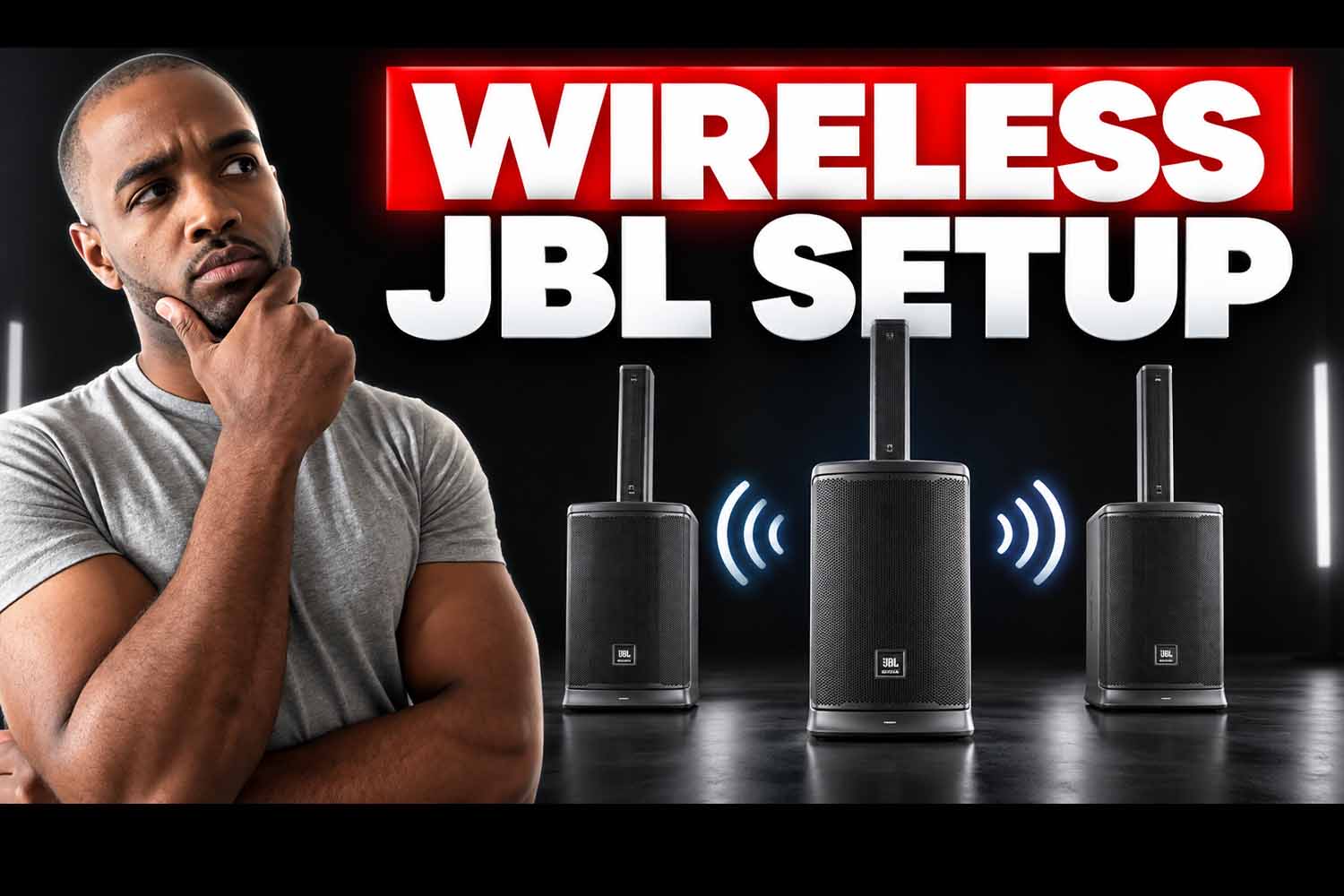
The foundation of the system is three JBL EON ONE MK2 column array speakers.
There were a few reasons these caught my attention.
First, they are battery powered. That gives me much more flexibility with placement at large venues, especially when outlets are limited or I want to avoid running power cables through guest areas.
Second, everything packs together extremely well. The column sections store inside the speaker, so I do not need separate speaker stands or traditional tripods.
For this setup, I was able to fit three JBL systems, my AlphaTheta OMNIS-DUO, my ProX table, microphones, wireless equipment, cables, a fan, and everything else I needed into the back of my Honda Civic hatchback.
That matters.
I am always looking at the entire workflow, not just how something sounds once it is turned on. If a speaker sounds great but requires another vehicle, more carts, additional stands, and a longer setup, that affects the value of the system.
Even with three speakers, I estimated this setup at roughly two and a half load-in trips. Without filming the process, I probably could have gotten it down to two.
The JBL Transporter bags also give me storage pockets for the Shure wireless equipment, XLR cables, and power cables. My one complaint so far is that when I use the Transporter without the wheel base, the cover does not completely protect the bottom of the speaker.
That is a relatively small issue, but it is something I noticed immediately.
Making the System Wireless with Shure SLX-D+
The part that really makes this system work for me is Shure SLX-D+.
I used an SLXD3+ plug-on transmitter to send audio and portable SLXD5+ receivers at the remote speakers. That allowed me to position speakers across the event space without running XLR cables between them.
The JBL speakers also have USB ports, which creates another nice benefit. I can power or charge pieces of the wireless system directly from the speakers while everything is running.
That reduces another battery management problem.
There was definitely some learning involved during this first setup.
Because I was sending one transmitter to multiple receivers, I did not want one receiver automatically changing frequencies and leaving the other receiver behind. I turned off the automatic interference updates and handled the system using a traditional scan-and-sync workflow.
Once I found clean frequencies and had everything communicating correctly, the system worked exactly the way I wanted.
I had one main speaker near my setup, a second speaker covering another section of the plaza, and a third speaker covering the back area.
Instead of one loud source trying to reach everyone, I now had three controlled sound zones.
Coverage Was the Biggest Win
This was the part I cared about most.
Once everything was balanced, the coverage across the venue was excellent.
I could walk from one area to another without experiencing the huge swings in volume that can happen when all of your sound is coming from one location.
The column array design also made a noticeable difference.
At this event, guests were standing and talking relatively close to the speakers. With a traditional point-source speaker aimed directly at them, that area could become uncomfortable quickly. The wider dispersion of the EON ONE MK2 allowed me to create coverage without making the space immediately in front of the speaker unusable.
That is exactly what I want for corporate events.
People still need to network. They still need to talk. The music needs to create energy without fighting every conversation in the room.
Distributed sound gives me more control over that balance.
I also set delays between the speakers after the event started. I used a simple pacing method to get close, then adjusted by ear until everything felt aligned. Nick Spinelli has a great video explaining speaker delays in more detail, and I actually watched his breakdown again on the way to this event.
Once the delays were dialed in, the system felt cohesive instead of sounding like three independent speakers.
My First Impression of the JBL EON ONE MK2
This was only the first test, so I am not ready to call this a full long-term review.
But my first impression is very positive.
The system was compact. The setup became faster as I learned it. Moving a speaker during the event was incredibly easy. Coverage was consistent, and the column arrays worked particularly well for an environment where people were socializing close to the sound system.
There are also things I will improve.
I am going to label and color-code the speakers, wireless units, and corresponding cables so I immediately know which equipment belongs together. That should remove some unnecessary thinking during setup.
The bigger test will be The Stack, which is the event this system was originally built for.
But this first event confirmed the idea.
For large corporate spaces, I am becoming much more interested in several strategically placed speakers than two extremely loud speakers trying to cover everything.
The objective is not maximum volume.
It is consistent, intentional coverage.
Big thanks to NLFX Pro for helping me get the JBL EON ONE MK2 systems. They have consistently supported the DJ community through education, conferences, sponsorships, and gear, which is something I value when choosing who I work with.
If you are planning a corporate event and need sound designed around the entire guest experience, reach out. If you are a DJ building a distributed wireless system, watch the video above to see exactly how this first test came together.