
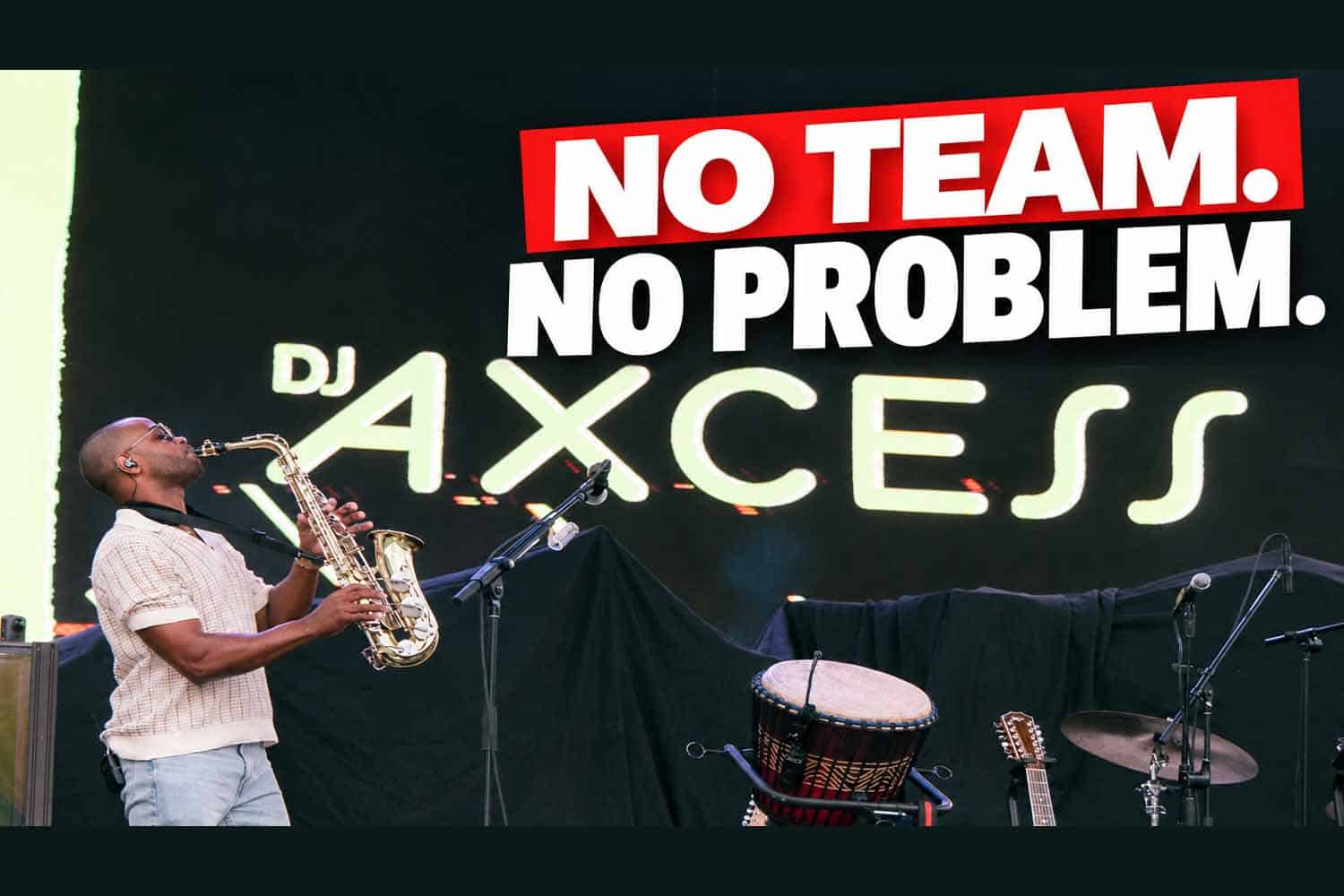
I DJed Abercrombie’s Challenge Music Festival Without My Team
Hey! I’m Mike, I go by DJ AXCESS, and I’m a DJ, musician, and public speaker based in Columbus, Ohio.
Watch the full video here: [YouTube Link]
One of the most important lessons I’ve learned from performing at major events is that if you’re not the one selling tickets, you’re not the one making the rules.
You have two choices when something doesn’t go your way. You can either quit, or you can make it work.
This year marked my fourth consecutive appearance opening the main stage at Abercrombie & Fitch’s Challenge Music Festival. The lineup included Maroon 5, The Lumineers, and Almost Monday, and I was excited to return for another year.
But this time, things were different.
Due to circumstances outside of Abercrombie’s control, I found out at the last minute that I wouldn’t be allowed to bring my usual team. No photographer, no videographer, and no manager.
I would be responsible for performing, managing my equipment, capturing content, and getting everything on and off the stage myself.
Here’s how I approached the situation and what other DJs can learn from the experience.
1. Understanding Your Role as an Opening DJ
Opening a music festival is very different from headlining one.
When you’re the opening act, your job is to contribute to the overall production while understanding that the entire event isn’t built around you.
That means your schedule, equipment, soundcheck, and even who you’re allowed to bring backstage can change.
At Challenge Music Festival, my performance was scheduled for 5:00 PM. I arrived at 3:00 PM, and by 3:20, I had completed load-in and received my credentials.
Two hours might sound like plenty of preparation time, but when you’re bringing DJ equipment, drums, a saxophone, multiple cameras, and personal belongings, that time disappears quickly.
We also weren’t going to have a traditional soundcheck before my set. That’s something I’ve experienced at this festival in previous years.
If you’re an opening DJ, you need to understand that production teams are managing an entire festival. There are multiple artists, changeovers, soundchecks, and schedules happening simultaneously.
Your ability to adapt without creating additional problems matters.
I’ve learned that being easy to work with is one of the reasons I continue getting opportunities like this.
2. Capturing Festival Content Without a Team
The biggest challenge wasn’t actually the performance.
It was figuring out how to document everything without a photographer or videographer.
Content is extremely important to what I do. Being able to show potential clients, other DJs, and event organizers what my performances look like helps me continue creating opportunities.
Normally, I’d have someone dedicated to capturing those moments.
This time, I had to build a system that could function without anyone operating the cameras.
My solution involved four different cameras.
First, I planned to position my Insta360 camera near the DJ booth. A 360 camera is incredibly useful because it can capture multiple perspectives without needing someone behind it.
Next, I used my DJI Osmo Pocket 3 to capture a wider perspective of the stage and surrounding environment.
I also brought two Canon R6 Mark II cameras.
One would be positioned to continuously capture photographs using an interval timer. Instead of relying on someone to press the shutter, the camera could automatically take photos throughout my performance.
The second camera was available in case I could find someone to take a few photographs. With the settings already configured, all they would need to do was point and shoot.
My backup plan was to extract still images from the video footage and make adjustments in Lightroom if necessary.
Was this as good as bringing a professional content team? No.
But it gave me a way to document the performance without interfering with the event.
That’s the important lesson. You should understand your equipment well enough to operate independently when necessary.
3. Preparation Makes Last-Minute Changes Manageable
One of the things I underestimated was how much equipment I actually brought.
Between my DJ equipment, wooden djembe, saxophone, cameras, tripods, and other accessories, I had a lot to manage.
And the distance between the green room and the main stage made things even more complicated.
After my performance, I estimated that I made approximately six trips between those areas. Each trip took several minutes, and I hadn’t really accounted for that.
Fortunately, the Abercrombie team provided two people to help me tear down.
I appreciated that because I know how many responsibilities production teams are juggling throughout an event.
But it also reinforced something I need to consider moving forward. There are situations where having at least one additional person isn’t just about getting content. It’s about managing equipment efficiently.
The other major challenge was soundcheck.
The previous soundcheck ran until approximately 5:02 PM, and I was playing music by 5:12 PM.
That gave me around ten minutes to get everything positioned and start performing.
I had DJ equipment, a saxophone, and a drum.
If you’re a DJ who’s interested in performing at festivals, practice your setup before you arrive.
Know where everything connects. Know your signal flow. Know what absolutely needs to happen before you can play music.
And practice setting everything up while someone is asking you questions or distracting you.
Because that’s what real events are like.
4. My First Music Festival Saxophone Performance
Another important part of this performance was bringing my saxophone onto a festival stage for the first time.
I’ve been incorporating live instrumentation into my DJ performances for years, particularly with my djembe.
But the saxophone is something I’ve been developing, and this was an opportunity to take another step forward.
I had planned to perform one song on saxophone during my set.
As the crowd grew, I started second-guessing that decision.
It’s one thing to practice an instrument in a comfortable environment. It’s another to play in front of a festival crowd.
I had that familiar conversation with myself.
One part of me was saying I wasn’t ready. The other part was telling me not to back out.
I decided to play.
Then, right as I picked up the saxophone, the microphone fell off.
Because I hadn’t been able to soundcheck the saxophone properly, I didn’t know what the microphone level would be.
Rather than introducing another unknown into the performance, I decided to play acoustically.
And I’m glad I did.
I missed one note because I caught an incorrect fingering before blowing into the instrument. But I didn’t play any wrong notes, and I finished the performance feeling good about what I’d accomplished.
It wasn’t perfect, but I followed through.
That’s how you develop confidence as a performer. You prepare, put yourself in challenging situations, and learn from the experience.
5. Professionalism Creates More Opportunities
Looking back, the biggest takeaway from this experience has very little to do with DJ equipment.
It’s about understanding your responsibilities and making the people around you feel confident.
I’ve been fortunate to perform at events like Lollapalooza and Challenge Music Festival, along with working with organizations like the Columbus Blue Jackets, Columbus Crew, and Ohio State Buckeyes.
I believe one of the reasons those opportunities continue coming my way is that people know I can handle challenging situations.
I understand that I’m part of a larger team.
I don’t expect every event to revolve around my needs, and I try not to create additional work for the people producing the event.
That doesn’t mean you should accept every restriction or avoid advocating for yourself.
After this experience, I may be firmer about having at least one person available to assist with equipment.
But there’s a difference between communicating what you need and becoming difficult to work with.
The DJs who understand that distinction put themselves in a better position to build long-term relationships.
Being talented matters. Being prepared matters. And making life easier for your clients and production partners matters just as much.
Final Thoughts
This year’s Challenge Music Festival reminded me that preparation isn’t about making sure everything goes according to plan.
It’s about being ready when it doesn’t.
I didn’t have my usual team, didn’t get a proper soundcheck, and had to figure out how to document the entire experience independently.
But I got on stage, delivered my set, played saxophone at a festival for the first time, and came away with lessons I’ll use at future performances.
Whether you’re performing at a wedding, corporate event, or major music festival, your ability to adapt is part of what makes you a professional.
If you’re planning an event and looking for a DJ who understands music, production, timing, and the responsibility of delivering a polished performance, connect with me.